




It’s Thursday, and Australia is recalibrating.
Retirement savings are being stolen in plain sight — $6.3 billion a year, quietly drained from workers who never see it coming. The Big Four accounting firms are finally facing scrutiny from the government. And the builders meant to solve the housing crisis say the real problem isn’t the code — it’s the system above it.
Meanwhile, Australians are getting creative at the checkout. Two in three would rather buy the ugly tomato than pay full price. That’s not a trend. That’s a shift.
This week’s Financial Register covers the policy decisions – and the daily trade-offs – that shape how Australians work, retire, build, and eat.
Please support us and spread the word to your family and friends about our newsletter. As always, contact us via email and don't forget to sign up for this newsletter here if you haven't already!
We'd love it if you could share the email with your friends! Just (copy the URL here.
In today’s email:
Unpaid Super Bill Reaches $6.3 Billion as Payday Laws Take Effect
Treasury Opens Audit and Consulting Regulation Review as Big Four Face Structural Break-Up Prospect
Building Governance Failures Threaten Australia’s 1.2 Million Home Target, Industry Body Warns
Digital Publishers Alliance Chair Calls for Urgent Government Action to Protect Australian Media Ecosystem
Cost-of-Living Squeeze Pushes Australians Toward Imperfect Produce and Unconventional Shopping
Today's reading time is 7 minutes. - Miko Santos 👇
MARKET CLOSE: 01 JULY26
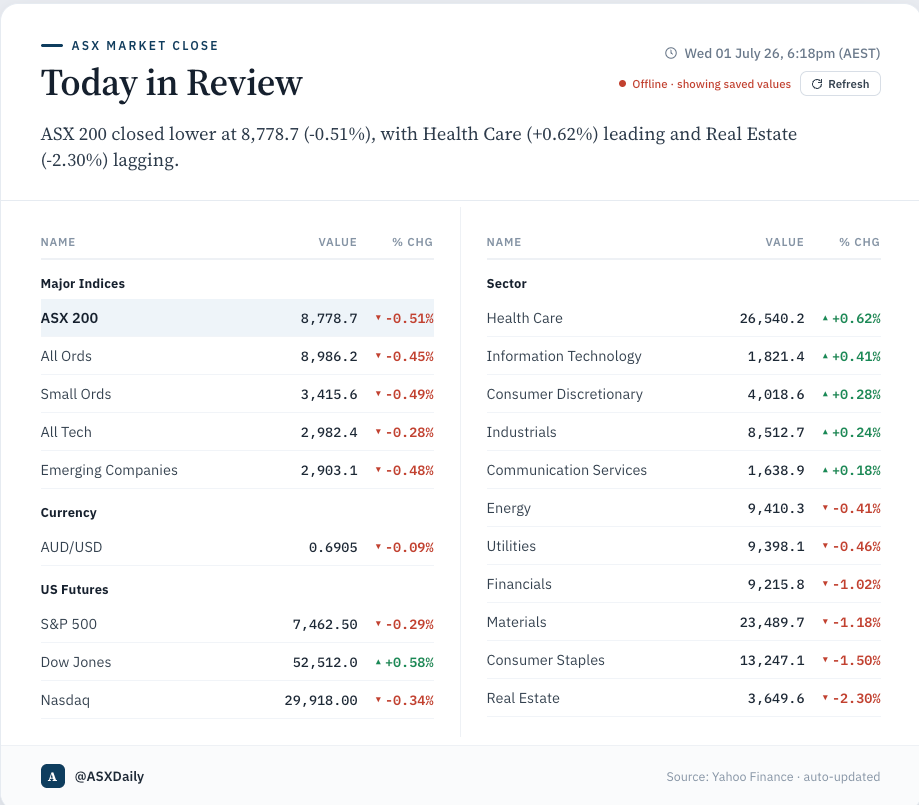
Data is provided by ASX Stock data as of At close 29/06 (AEST)

Unpaid Super Bill Reaches $6.3 Billion as Payday Laws Take Effect
What happened
New analysis of Australian Taxation Office data by the Super Members Council shows unpaid superannuation now costs Australian workers $6.3 billion annually in lost retirement savings — a $500 million increase on the prior year. The findings land on the same day payday super legislation comes into force, requiring employers to pay superannuation contributions at the same time as wages rather than quarterly.
Why it matters
The scale of underpayment is broad and the individual impact is compounding. More than one in four workers — approximately 3.4 million Australians — were underpaid an average of $1,850 in superannuation during 2023-24, up from $1,730 the year before. Over a working life, the ATO estimates the loss of compounding investment returns could leave some workers more than $30,000 worse off at retirement. The problem falls hardest on those least able to absorb it: women, who already retire with roughly a quarter less super than men, are disproportionately affected, as are younger workers and low-income earners — with one in two workers earning less than $25,000 a year carrying unpaid super entitlements. NSW alone recorded underpayments exceeding $2 billion, while Western Australia and NSW shared the highest proportion of underpaid workers at 29% each.
Zoom out
The quarterly payment model has long been identified as a structural enabler of underpayment — infrequent remittance cycles create both administrative lag and opportunities for cashflow-driven non-compliance that are difficult for workers to detect in real time. The payday super reform closes that gap by synchronising super payments with payroll, making discrepancies immediately visible through single touch payroll reporting systems already available to all employers. The transition is already underway: since the policy was announced, around 19,000 additional employers have shifted to paying super more frequently than quarterly, a 2.4 percentage point increase. The ATO has confirmed it will take a graduated enforcement approach in the first 12 months, concentrating compliance resources on the highest-risk cases rather than penalising businesses still adapting to the new cadence. Super Members Council CEO Misha Schubert estimates the reform could add more than $9,000 to the average worker’s retirement balance through the compounding effect of more frequent contributions.
Bottom line
The $500 million single-year blowout in unpaid super — despite years of policy focus on the issue — demonstrates that quarterly remittance cycles were structurally incapable of containing the problem. Payday super doesn’t just change when employers pay; it changes how detectable non-compliance becomes, which is ultimately what enforcement depends on. Today marks the shift from a system that tolerated a $6.3 billion annual transfer away from workers’ retirement savings to one designed to make it visible and recoverable in near real time.

TOGETHER WITH MENCARI TRAVEL WIRE
Your Next Adventure Starts Here

Mencari Travel Wire is the go-to travel newsletter for Australia and New Zealand — delivering destination guides, travel intel, and trip-planning essentials curated for readers who move with purpose. Whether you’re chasing weekend escapes or planning your next big journey across the Tasman, we’ve got you covered.
Subscribe Free → TRAVEL WIRE
This section is a paid advertisement. If you are interested in advertising, let’s talk.
Treasury Opens Audit and Consulting Regulation Review as Big Four Face Structural Break-Up Prospect
What happened
The Australian Treasury has released a consultation paper examining regulatory gaps in the accounting, auditing and consulting sector, with a separation of audit and consulting activities among the options under consideration. Assistant Treasurer Dr Daniel Mulino announced the review today. Chartered Accountants Australia and New Zealand (CA ANZ), which represents more than 140,000 financial professionals, has welcomed the consultation and committed to engaging constructively with Treasury and ASIC on the design of any reforms.
Why it matters
The potential structural separation of audit and advisory functions would represent the most significant change to the Big Four business model in decades. At issue is a structural incentive conflict that regulators have allowed to persist: firms are simultaneously expected to provide independent assurance over financial statements while competing for the same clients’ highly profitable consulting mandates. RMIT University finance professor Angel Zhong characterised the dynamic plainly — the Big Four have effectively been assessing their own work, and Treasury is now considering whether that arrangement remains tenable. The quality of audit assurance is not an abstract governance question for businesses, superannuation funds, and government agencies that rely on these opinions to make decisions. It is the foundation on which capital allocation, financial reporting credibility and regulatory compliance rest.
Zoom out
Australia’s review sits within a broader international recalibration. Regulators across multiple jurisdictions are reassessing whether traditional partnership structures and self-regulatory frameworks remain appropriate for professional services firms that have grown into large, globally interconnected and politically influential institutions. The Australian context has been sharpened by a sequence of high-profile scandals — most notably the PwC tax leaks affair — that demonstrated how consulting relationships and confidential government access can coexist in ways that compromise both. CA ANZ’s statement is notable for its tone: the body acknowledged that its own disciplinary processes, strengthened by member vote in October 2023, are insufficient on their own, and that the regulatory framework around audit must keep pace with what professional bodies can deliver internally. That is an unusual admission from a peak body, and it signals that the profession’s credibility problem is severe enough that sector representatives are actively inviting external oversight rather than resisting it. The ATO notes that the options paper presents a wide range of measures requiring careful consideration, particularly to avoid unintended consequences for smaller firms that operate very differently from the Big Four.
Bottom line
Treasury’s consultation must answer whether the preferred remedy is structural separation, enhanced independent oversight, or a combination of both, because evidence shows current governance arrangements are inadequate. Professor Zhong’s framing is instructive: the success of any reform will be measured not by how firms are reorganised but by whether confidence in audit independence is genuinely restored. Structural change that fails to address the underlying incentive problem would leave the core issue intact.
TFR JOB BOARD
Field Marketing Specialist, ANZ at Twillio. As the field marketing specialist, you will report to Twilio's field marketing director, ANZ, and play a critical hands-on role in executing marketing programmes and campaigns across the ANZ region.
Account Manager at NZME. This role will involve crafting innovative media solutions that enhance our market profile, driving sales targets, and exploring new business opportunities.
Team Lead, Account Management at FareHarbor. The Account Management Lead – APAC is responsible for driving commercial performance and elevating leadership standards across the regional portfolio.
Building Governance Failures Threaten Australia’s 1.2 Million Home Target, Industry Body Warns
What happened
The Building Products Industry Council (BPIC) has warned that Australia’s national housing target of 1.2 million new homes is being jeopardised by structural failures in the building governance system — not the building code itself. The peak body, which represents industries directly employing more than 243,000 Australians, made the call in response to Federal Treasury’s ongoing NCC Modernisation Project, arguing the review is focused on the wrong problem.
Why it matters
BPIC Executive Officer Rodger Hills said the current governance model — anchored by an intergovernmental agreement (IGA) between state and territory building ministers — is producing the opposite of its intended effect. Rather than delivering national consistency, the system is generating conflicting state policies, opaque decision-making, and no meaningful feedback mechanism for industry or the public. Building ministers’ meetings are irregular, lack consistent agendas, and exclude industry input entirely. Hills described these as “structural failures that directly affect housing supply, productivity and the cost of building in Australia” — outcomes felt not just by the construction sector but by homebuyers, renters, and anyone waiting for new housing stock to materialise.
Zoom out
The critique carries weight given the NCC Modernisation Project’s final report is due in October-November 2026, making the window for course correction narrow. BPIC’s position is that reforming the National Construction Code without overhauling the governance architecture above it is an exercise in futility — “like renovating a house on weak foundations,” as Hills framed it. The body is calling for a package of structural reforms: regular and transparent building ministers’ meetings with direct industry input; a restructured IGA with clear medium and long-term priorities; elevation of the Australian Building Codes Board to statutory body status; early industry engagement on proposed code changes; and measurable performance indicators for regulatory outcomes. These are not novel concepts in regulatory design — statutory bodies, transparency requirements, and performance benchmarking are standard features of functional national frameworks in other sectors. Their absence from building governance reflects how long the system has operated without meaningful accountability.
Bottom line
Australia’s housing ambition is running on a governance model that was already struggling before construction demand intensified. BPIC’s intervention puts a clear choice to the Treasury review: use the October deadline to address the IGA and governance architecture, or produce a modernised code that the same dysfunctional system will continue to implement inconsistently. The building products sector is effectively arguing that the government cannot code its way out of a governance problem.
Digital Publishers Alliance Chair Calls for Urgent Government Action to Protect Australian Media Ecosystem
Tim Duggan, Chair of the Digital Publishers Alliance (DPA) and founder of the former independent media company Junkie Media, used a keynote address at the National Press Club in Canberra to outline three existential threats facing Australia’s media industry and propose four concrete policy solutions, urging the federal government to act immediately to prevent irreversible damage to the country’s democratic information infrastructure.
What Happened
Duggan, speaking before an audience that included News Corp Executive Chairman Michael Miller, Greens Communications Spokesperson Senator Sarah Hanson-Young, and representatives from more than 150 independent digital publishers, framed Australia’s media landscape as a “Great Media Reef” — a complex, interdependent ecosystem that he assessed as sitting somewhere between “vulnerable” and “endangered” on a conservation-style threat scale.
He identified three primary threats: the predatory conduct of global big tech and AI platforms; sustained government paralysis in responding to that conduct; and an accelerating crisis of trust fuelled by misinformation and AI-generated content.
Why It Matters
The consequences Duggan described are neither abstract nor distant. Google’s shift to AI-generated search overviews has already caused a 33% decline in referral traffic to news publishers globally over the past year alone, fracturing what had been a functionally symbiotic relationship between search and publishing. Meta, meanwhile, abandoned Australia’s News Media Bargaining Code more than two years ago — and in the period since, the Australian government has continued directing an estimated portion of approximately $200 million in digital advertising spend toward Meta and Google, rewarding platforms that have actively harmed the local industry.
The AI dimension compounds the threat further. Duggan cited data suggesting that one major AI company scrapes approximately 24,000 pages of publisher content for every single human referral it returns — a ratio he described as illustrative of “what a broken ecosystem looks like.” He disclosed that his own published books — Cult Status, Killer Thinking and Work Backwards — were among 7.5 million titles allegedly ingested without payment through the pirated Library Genesis catalogue, used by Meta, OpenAI and Anthropic to train their models.
The trust dimension is measurable: three in four Australians report concern about distinguishing real from fake content online, the highest rate of such concern recorded anywhere in the world. Duggan linked declining news consumption directly to a reduced capacity for misinformation detection and increased political polarisation.
Zoom Out
Duggan’s address arrives at a moment of genuine structural fragility for independent Australian publishing. While large organisations like Nine, Seven, News Corp, and national broadcasters ABC and SBS have the resources to weather market disruption, smaller and mid-sized independent publishers — which Duggan described as the most agile and community-connected part of the ecosystem — do not have the balance sheets to absorb prolonged platform hostility and legislative delay.
The government again pushed back the proposed News Bargaining Incentive, its successor mechanism to the news media bargaining code, from the parliamentary agenda in the days before the address. For Duggan, the pace mismatch is structural: “The slow speed of government is being strangled by the fast pace of technology.”
His four proposed solutions carry genuine policy precedent. A tax offset for journalist salaries, modelled on the existing 30-to-40% producer offset for film and television content — which returned $713 million to the Australian screen industry in the last financial year — could, according to economic analysis by expert Megan Brownlow, generate approximately $216 million annually for journalism if applied at a comparable rate. Denmark, Sweden, France and Canada have all deployed similar tax reduction schemes for news industries.
On copyright, Duggan argued that the enforcement mechanism already exists: the Copyright Act, in operation since 1968 and administered through the Copyright Agency for more than 50 years, already provides the licensing framework AI companies claim is unworkable. Media monitoring companies such as Isentia and Meltwater already operate under licensed content-scraping arrangements. The argument that AI companies cannot do the same, Duggan suggested, was not a technical constraint but a political choice.
On government advertising, the $250 million annual federal advertising budget currently flowing substantially to offshore platforms represents a lever that has, according to Duggan, never been modelled against the alternative: the combined reach of every domestic television network, out-of-home operator, magazine, radio station, independent publisher and community newspaper. He pointed to New York City’s 2019 commitment to direct at least 50% of its print and digital advertising to community and ethnic media — an initiative that reached more than 220 outlets in its first year — as an existing proof of concept.
The fourth proposal, a restructured News Bargaining Incentive with an explicit set-aside for smaller independent publishers, would address what Duggan characterised as the central failure of the original bargaining code: that its benefits flowed overwhelmingly to the largest media organisations, leaving independent publishers underserved. A rare joint statement from the DPA, Local Independent News Association, Community Broadcast Association of Australia, Public Interest Journalism Initiative, Independent Multicultural Media Australia, and the Alliance for Journalist Freedom – the first such united position from smaller publisher bodies – formally endorsed this principle.
Cost-of-Living Squeeze Pushes Australians Towards Imperfect Produce and Unconventional Shopping
What happened
New consumer research from ING Australia, released June 26, shows that an estimated two in three Australians (65%) would buy imperfect-looking produce to save money on groceries, with 86% having taken at least one cost-reduction action on fruit and vegetables in the past 12 months. The findings, drawn from ING’s consumer insights research, reflect sustained household budget pressure reshaping how Australians approach food spending.
Why it matters
The behavioural shifts are both broad and deepening. More than seven in ten Australians say rising fresh produce costs are actively changing their shopping decisions — with strict seasonal shopping (37%) and discounted produce (35%) among the most common adaptations. A meaningful share are moving beyond supermarkets entirely: one in six have grown their own produce or sourced food through community and neighbour networks, while one in eight are now preserving surplus fruit and vegetables instead of discarding them. Separately, ING’s Sense of Us 2026 report found that 55% of Australians have adjusted their diets outright to offset grocery cost increases — suggesting that the imperfect-produce trend sits within a wider pattern of dietary compromise rather than simply savvy shopping. ING Head of Consumer and Market Insights Matt Bowen described the response as “shopping smarter” rather than cutting back, though the distinction between the two is narrowing for many households.
Zoom out
The generational split in the data is telling. Older Australians — Gen X and Baby Boomers — are significantly more willing to accept cosmetically imperfect produce (51% and 50% respectively) than younger cohorts (Gen Z at 34%, Millennials at 38%). Younger generations, however, are more prepared to sacrifice convenience — around 29% of Gen Z and Millennials versus 16% of Gen X and 14% of Baby Boomers — suggesting different but equally pragmatic responses to the same budget pressure. The willingness of 71% of respondents to acknowledge that cosmetically graded produce going to waste bothers them points to an emerging alignment between financial self-interest and waste reduction attitudes. Retailers and food producers have long faced resistance to imperfect produce programs; sustained cost-of-living pressure may accomplish what sustainability campaigns have not.
Bottom line
When 86% of the population is actively modifying grocery behaviour within a single year, it crosses from trend into structural shift. The cosmetic standards that have historically governed supermarket ranging decisions — and driven significant food waste upstream — are colliding with household budget reality in a way that creates both commercial opportunity for retailers willing to act on it and a policy question about whether existing produce grading conventions remain fit for purpose.
SUPPORT MENCARI
The Mencari - Australia's Politics delivers fact-focused reporting to over 1,000 inboxes thanks to readers like you, and your contribution today will strengthen our ability to provide verified, evidence-based journalism completely free from financial or political influence as we work to establish ourselves as Australia's premier independent news organization focused on accountability through thorough investigation.
Not ready to be paid subscribe, but appreciate the newsletter ? Grab us a beer or snag the exclusive ad spot at the top of next week's newsletter.
FROM OUR TEAM
📖 I appreciate you taking the time to read! See you in the next issue. Got a question or criticism? Just click on Reply. We can talk while we are here.
🎧 Check out our podcasts. This podcast seeks the truth to answer the most pressing questions using the highest journalistic standards
✍️ Give us a press release and a good-sized landscape photo. Make sure it's newsworthy. Send press releases to newsdesk@readmencari.com or click here. Editorially, we may rewrite headlines and descriptions.
🚀 Got a news tip ? Contact our editor via Proton Mail encrypted, X Direct Message, LinkedIn. You can securely message him on Signal by using his username, Miko Santos.
