

Sydney and Melbourne Auction Clearance Rates Hit Multi-Year Lows Amid Budget-Driven Market Squeeze



It's Tuesday! Australia’s mood is souring — well-being is down, trust in Washington is at a record low, and property auctions are showing their weakest results since COVID.
But Australians aren’t passive. They’re cutting spending, moving their bodies, and quietly rethinking who matters most on the world stage.
Please support us and spread the word to your family and friends about our newsletter. As always, contact us via email and don't forget to sign up for this newsletter here if you haven't already!
We'd love it if you could share the email with your friends! Just (copy the URL here.
In today’s email:
Australians Lean on Healthy Habits, Tight Budgets as Wellbeing Index Falls to 61.9
Self-Directed Investors Urged to Use EOFY as Portfolio Review Moment
Sydney and Melbourne Auction Clearance Rates Hit Multi-Year Lows Amid Budget-Driven Market Squeeze
Today's reading time is 7 minutes. - Miko Santos
MARKET CLOSE: 29 JUNE 26
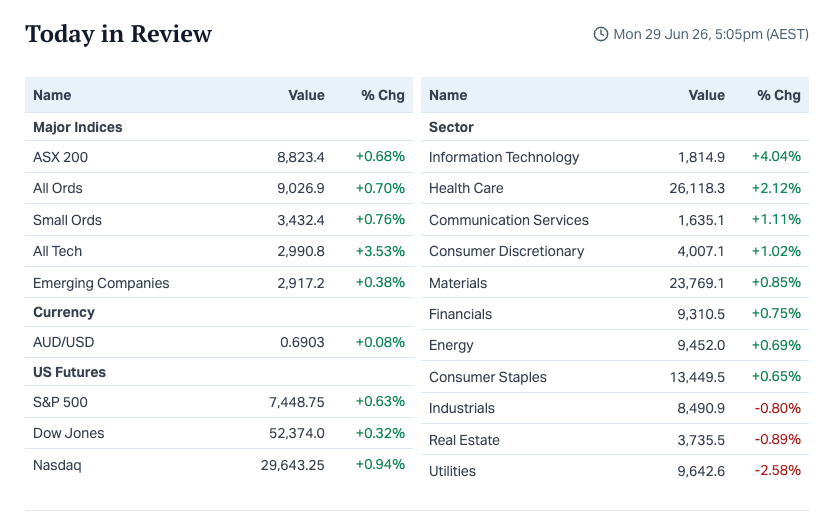
Data is provided by Market Index. Stock data as of At close 29/06 (AEST)

Australians Lean on Healthy Habits, Tight Budgets as Wellbeing Index Falls to 61.9
What happened
Australia’s national wellbeing index dropped 2.2 points to 61.9 in Q2, according to NAB’s latest Wellbeing Survey, with the cost of living remaining the dominant pressure point alongside health costs, housing affordability, and work and income stress.
Why it matters
The headline index decline masks a more interesting behavioural signal: Australians aren’t passive under pressure. Nearly half (47%) are actively cutting non-essential spending, more than a third (35%) have increased physical activity, and roughly one in four are building budgets or shopping around to switch providers for savings. The data suggests a population recalibrating around controllables — routines, sleep, connection, mindfulness — rather than waiting for macroeconomic relief that has yet to arrive. For financial services, retail, and wellness operators, this behavioural pivot has direct commercial implications.
Zoom out
The Q2 reading fits a broader pattern visible across developed economies: when sustained cost pressure outlasts consumers’ tolerance for abstract optimism, they shift into what behavioural economists call “efficacy-seeking” — prioritising actions that restore a sense of agency even when the underlying stressors remain unchanged. That’s the market logic behind the simultaneous rise in budget apps, breathwork studios, and discount grocery formats. The 19% using mindfulness techniques and the 26% building spending plans aren’t separate trends — they’re the same psychological impulse expressed across different spending categories. The wellness industry, in particular, has historically outperformed in late-cycle consumer stress environments precisely because low-cost, high-agency products (breathwork, journaling, community fitness) offer tangible relief without requiring discretionary outlay. NAB’s observation that “early signs things may be easing” is doing a lot of hedging work in what is otherwise a story about persistent strain.
Bottom line
The decline in wellbeing is real, but the more useful information for market participants is the behavioural adaptation data: Australians under financial stress are still spending, just in different ways, with a strong preference for products and services that restore control, connection, and routine.

TOGETHER WITH MENCARI TRAVEL WIRE
Your Next Adventure Starts Here

Mencari Travel Wire is the go-to travel newsletter for Australia and New Zealand — delivering destination guides, travel intel, and trip-planning essentials curated for readers who move with purpose. Whether you’re chasing weekend escapes or planning your next big journey across the Tasman, we’ve got you covered.
Subscribe Free → TRAVEL WIRE
This section is a paid advertisement. If you are interested in advertising, let’s talk.
Self-Directed Investors Urged to Use EOFY as Portfolio Review Moment
What happened
InvestmentMarkets CEO Darren Connolly called on Australia’s self-directed investors Monday to treat the end of the financial year as a portfolio management opportunity rather than a routine administrative milestone, as the June 30 deadline approaches.
Why it matters
For the country’s growing cohort of self-managed investors, EOFY represents one of the few natural points in the calendar where portfolio scrutiny is both timely and culturally expected. Connolly said many investors fall into the trap of focusing on compliance tasks while overlooking a more consequential question: whether their existing holdings still make sense.
“Investors spend a lot of time ticking boxes, but often the most valuable exercise is reviewing existing holdings and asking a simple question: would I make the same investment decision today?” Connolly said. “If the answer is no, that asset deserves closer scrutiny.”
Concentration risk — where capital becomes too heavily weighted in a single asset, sector, or structure — is among the most common and underexamined problems he identified. With self-directed investors increasingly holding assets across multiple platforms and investment structures, Connolly argued that EOFY is the ideal moment to consolidate that information and assess the full picture.
Zoom out
The call comes against a backdrop of meaningful structural change in Australia’s retail investment landscape. Shifting interest rate expectations, ongoing geopolitical uncertainty and broader access to private market products have complicated portfolio construction for investors who manage their own capital. InvestmentMarkets, which lists more than 750 products across 20 asset categories, is among the platforms that have expanded that access — but Connolly acknowledged that availability alone does not equal informed decision-making.
“The challenge is making informed decisions, maintaining a clear investment framework and ensuring capital is being deployed where it has the strongest potential to support long-term objectives,” he said.
This highlights a wider tension in the self-directed investor market: product availability has outpaced financial literacy infrastructure, leaving more individual investors navigating complex allocations without professional guidance.
Bottom line
The practical advice here is straightforward: use June 30 as a forcing function to ask whether every holding in your portfolio would survive a fresh investment decision today. Many investors who haven’t closely examined diversification or concentration risk since last EOFY may find the answer more uncomfortable than expected.
TFR JOB BOARD
Business Manager - Agency at Sky New Zealand. The business manager works alongside a business director to support revenue generation through proactive account management and the identification of sales opportunities for Sky.
Account Manager at ARN. Wave FM is looking for an account manager to join their team to develop solutions that give local brands a voice and drive revenue growth for the station.
Partnerships Associate, Australia at Whatnot. Become the go-to expert on your category, including seller/buyer dynamics, community channels, influencers, and product nuances.
Business Lead at Akcelo. The Business Lead is a senior, client-facing leadership role within Akcelo’s Account Management team.
Relationship Manager at ANZ. As a commercial relationship manager, you will play a pivotal role in developing, managing, and growing a portfolio of customers by fostering strong, long-term relationships.
Australians' Trust in U.S. Hits Record Low as Economic Pessimism Surges, Lowy Poll Finds
What happened
Australian trust in the United States has fallen to its lowest level in the 22-year history of the Lowy Institute Poll, with just 31 percent of Australians saying they trust Washington to act responsibly in world affairs — a 25-point collapse from 2024. The 2026 poll, released June 23, also recorded the highest economic pessimism ever measured in the survey’s history, with 59 percent of Australians now pessimistic about the country’s economic performance over the next five years.
Why it matters
The numbers represent a fundamental shift in how Australians perceive their place in the world, not just a reaction to a single political figure. Confidence in President Donald Trump stands at 21 percent — the lowest recorded for any U.S. president in Lowy’s polling history — with 60 percent of respondents saying they have “no confidence at all” in him to do the right thing in world affairs. More striking still: for the first time in the poll’s history, a majority of Australians (51 percent) now say the relationship with China is more important than the one with the United States. Trust in China, meanwhile, has risen eight points to 28 percent, narrowing the gap between the two superpowers to just three percentage points — down from 53 points in 2022.
Zoom out
The poll captures a public in the middle of a significant worldview recalibration. Economic anxiety is running hotter than at any point during the COVID pandemic or the Global Financial Crisis, suggesting the current unease isn’t being driven by a discrete shock but by something more structural — a diffuse sense that the global order underpinning Australian prosperity is becoming less reliable. That anxiety is spilling into domestic attitudes as well: support for cultural diversity has recorded the largest two-year movement on any societal question in the poll’s history, dropping nearly 20 points from 90 percent in 2024 to 73 percent today, while 64 percent of Australians now say AI’s risks outweigh its benefits, up 12 points since 2024. The one area of relative stability is AUKUS — two-thirds of Australians still support the nuclear-powered submarine program — but even alliance support has fallen seven points in a single year, the sharpest sustained drop the poll has recorded.
Bottom line
Australia’s strategic consensus — that the U.S. alliance is the bedrock of national security and that openness is a net positive — is eroding faster than at any point in a generation, driven by a combination of Trump-era disillusionment, economic anxiety, and a public increasingly skeptical of the institutions and trends that defined the post-Cold War era.
France Heatwave Disrupts Flights, Closes Attractions as Heat Persists Across Country
What happened
France is experiencing its most intense early-summer heatwave on record, with Météo-France running its national alert system at peak levels since June 16. At the height of the event on June 24, up to 58 departments were placed under a red heatwave alert, with around 90 departments under red or orange in total, covering roughly 91 percent of the population. As of June 29, the red alert over Paris and Île-de-France has eased to orange, but the heat has not fully broken.
Why it matters
The disruption is tangible for anyone with France on their itinerary. Flight-tracking aggregators reported roughly 1,150 delays and around 50 cancellations across French airports in a single day, with Paris Charles de Gaulle the hardest hit at about 477 delays and 13 cancellations, and Paris Orly close behind at about 292 delays and 8 cancellations. Beyond airports, major attractions have cut or reorganized their hours — the Eiffel Tower and the Louvre both imposed early 4 p.m. closures during the peak, while Mont Saint-Michel urged visitors to postpone trips entirely during the red alert period. The health risk is also material: French health authority Santé publique France has linked roughly 1,000 excess deaths to this heatwave episode.
Zoom out
This event fits a pattern of increasingly severe early-season heat events across Europe that are compressing the traditional summer travel window and forcing tourism infrastructure — airports, rail networks, heritage attractions — to adapt in real time rather than in advance. Extreme heat affects aviation in concrete ways: high temperatures reduce aircraft performance, soften tarmac, and strain ground crews working in the open, while storms that often follow a heat spike add further delays. The broader implication for travel operators and insurers is that heatwave disruption is no longer a rare exception to be managed reactively — it is a recurring operational variable requiring contingency planning on par with industrial action or severe storms.
Bottom line
Foreign offices are advising caution rather than telling people to stay away, but travelers heading to France should expect schedule changes, possible flight and rail delays, and real health risks from extreme heat — and should confirm attraction hours, flight status, and local alert levels before departing.
Sydney and Melbourne Auction Clearance Rates Hit Multi-Year Lows Amid Budget-Driven Market Squeeze
What happened
Australia’s housing auction market recorded its weakest results in years over the weekend of June 28, with a preliminary national clearance rate of 49.2 percent — meaning fewer than half of all homes taken to auction found a buyer, according to property research firm Cotality. Sydney’s clearance rate of 47.3 percent was its lowest since April 2020, while Melbourne’s 50.2 percent result was its weakest since the COVID-19 lockdowns of September 2021. Cotality estimates the final figure will fall closer to 40 percent once all results are counted.
Why it matters
A clearance rate above 60 percent is the industry benchmark for a balanced market — so readings in the high 40s represent meaningful weakness, not a rounding error. AMP deputy chief economist Diana Mousina pointed to budget changes as a key near-term driver, noting that upcoming negative gearing restrictions — which from July 2027 will limit the concession to new builds only — are weighing on investor demand for established properties. The capital gains tax discount is also being overhauled, replaced with an inflation-based system and a minimum 30 percent tax on gains. AMP now expects home prices to fall about 5 percent over the next year. Brisbane fared worst of any capital city at 39.3 percent, while Adelaide bucked the trend with a 68.7 percent clearance rate on auction volumes that jumped nearly 24 percent.
Zoom out
The results land at an inflection point for Australian housing policy. The May budget changes represent the most significant structural intervention in property taxation in decades, and the market is beginning to price them in ahead of their implementation. Mousina flagged the dynamic clearly: supply constraints will put a floor under prices, but softening investor demand and a reluctance among sellers to list into a weak market could leave prospective buyers frustrated even as headline prices ease. Treasurer Jim Chalmers appeared on ABC Insiders to downplay the data, drawing comparisons to the 2022 rate rise cycle — a signal the government is not inclined to walk back the reforms in response to short-term market softness.
Bottom line
The auction data suggests the property market is repricing around the government’s tax changes before they even take effect — and with AMP forecasting a 5 percent price fall, the next 12 months will test whether Canberra’s housing affordability wager delivers relief for buyers or simply cools a market without fixing the underlying supply problem.
SUPPORT MENCARI
The Mencari - Australia's Politics delivers fact-focused reporting to over 1,000 inboxes thanks to readers like you, and your contribution today will strengthen our ability to provide verified, evidence-based journalism completely free from financial or political influence as we work to establish ourselves as Australia's premier independent news organization focused on accountability through thorough investigation.
Not ready to be paid subscribe, but appreciate the newsletter ? Grab us a beer or snag the exclusive ad spot at the top of next week's newsletter.
FROM OUR TEAM
📖 I appreciate you taking the time to read! See you in the next issue. Got a question or criticism? Just click on Reply. We can talk while we are here.
🎧 Check out our podcasts. This podcast seeks the truth to answer the most pressing questions using the highest journalistic standards
✍️ Give us a press release and a good-sized landscape photo. Make sure it's newsworthy. Send press releases to newsdesk@readmencari.com or click here. Editorially, we may rewrite headlines and descriptions.
🚀 Got a news tip ? Contact our editor via Proton Mail encrypted, X Direct Message, LinkedIn. You can securely message him on Signal by using his username, Miko Santos.
