

Gas Prices Rise as Middle East Tensions Flare; Housing Policy Sparks Debate in Australia


Good morning, Australia!
Four minutes. Three stories. Everything you need to know.
Today’s Brief cuts through the noise to deliver the news that actually matters—stories that affect your wallet, your world, and your tomorrow. From geopolitical standoffs threatening global oil supplies to policy decisions reshaping housing markets, we break down complex events with clarity and context, told in a conversational voice that respects your time and your intelligence.
New episodes every weekday morning. Stay informed without the overwhelm.
Despite the financial challenges that our industry faces, we have decided to keep our reporting open to the public because we believe that everyone is entitled to know the truth about the events that shape their world.
Thanks to the unwavering support of our readers, we’re able to keep the news flowing freely. If you’re able, please join us in supporting Mencari.
Please support us and spread the word to your family and friends about our newsletter. As always, contact us via email and please remember to sign up for this newsletter here if you haven't already!
We'd love it if you could share the email with your friends! Just (copy the URL here.
In today’s email:
Oil spikes on strait of Hormuz tensions; fuel price rise
US-Iran military escalation threatens return to open war
Australia‘s multilingual house ads ignite political firestorm
🎧 Listen to the podcast
Today's reading time is 7 minutes. - Miko Santos 👇
MARKET CLOSE: 01 JULY26
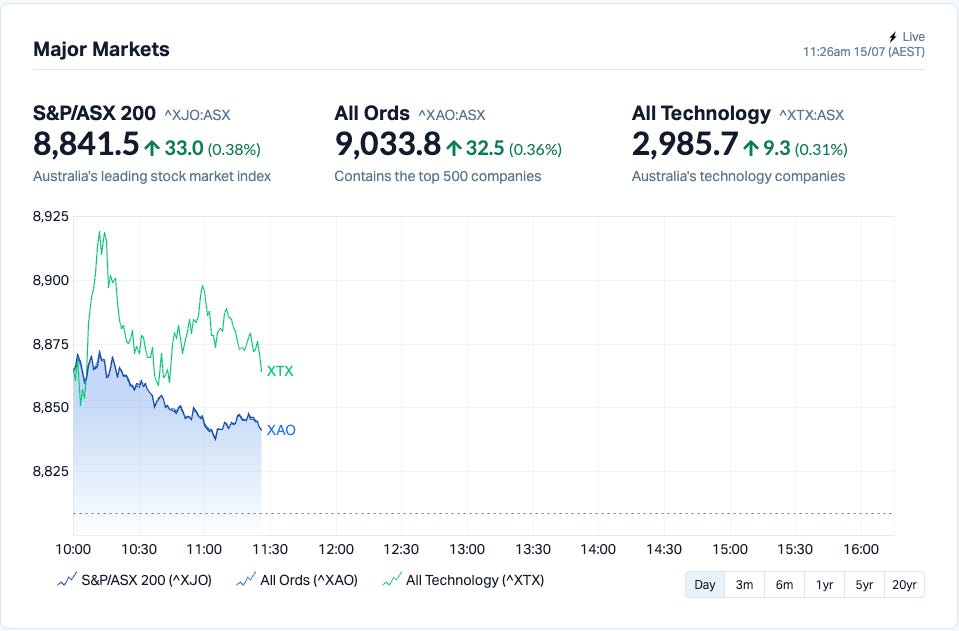
Data is provided by MARKET INDEX

OIL SPIKES ON STRAIT OF HORMUZ TENSIONS; FUEL PRICES RISE
Crude oil prices surged more than 4 percent Monday as military tensions between the United States and Iran escalated over control of the Strait of Hormuz, sending ripples through global energy markets and triggering the first significant increase in gasoline prices in weeks.
Brent crude, the international benchmark, rose 3.92 percent to $78.99 a barrel, while the national average for a gallon of regular gasoline climbed 5 cents overnight to $3.84, according to data from AAA. The uptick marks a reversal of three weeks of declining prices and signals renewed concern among traders about potential supply disruptions.
The spike occurred as the U.S. military conducted multiple rounds of strikes against Iranian targets in retaliation for Iranian attacks on commercial shipping in the waterway, through which approximately one-third of the world’s seaborne oil passes daily.
“Every time they hit us, we hit them 20,” President Donald Trump told reporters aboard Air Force One, characterizing the tit-for-tat military escalation as punishment for Iranian violations of a ceasefire agreement signed last month.
The Supply Chain Effect
Market analysts warn that sustained elevated oil prices could accelerate inflation and squeeze consumer spending in an economy already navigating uncertainty. Oil prices climbed from a low of $68 per barrel in early July to nearly $79 following the weekend strikes.
“What we’re seeing is a classic geopolitical risk premium being priced into the market,” said Bob McNally, founder and president of Rapidan Energy Group. “But the increase is ‘pretty tame’ given the severity of the military exchanges, suggesting traders believe escalation will remain contained.”
Diesel prices present a particular concern for the broader economy. With crack spreads—the profit margin refiners add to crude—surging to four-year highs, diesel fuel costs are expected to rise sharply. Since diesel powers trucking, agriculture, and rail transport, higher prices could eventually translate into increased costs for groceries, consumer goods, and shipping.
Competing Outlooks
Mukesh Sahdev, chief oil analyst at XAnalysts in Sydney, expects Brent crude to remain in the upper $70s during August and September amid heightened geopolitical uncertainty. “Long-haul procurement forces refiners to make supply decisions weeks in advance,” Sahdev noted. “Those decisions have already reduced immediate reliance on the Middle East, and the latest escalation is likely to reinforce rather than reverse that trend.”
However, some analysts remain skeptical about a sustained price surge. J.P. Morgan Global Research maintains its forecast that Brent crude will average around $60 per barrel in 2026, citing what it describes as “soft supply-demand fundamentals” and Trump administration reassurances about keeping the Strait of Hormuz open to avoid “a real economic and financial catastrophe.”
Still, White House officials have indicated they view elevated oil prices as preferable to allowing Iranian control of critical shipping lanes, signaling potential tolerance for higher fuel costs as a price of maintaining geopolitical leverage.
The average U.S. gasoline price remains roughly 30 percent higher than when the war began in late February but 21 cents lower than a month ago, according to AAA data.

TOGETHER WITH MENCARI TRAVEL WIRE
Your Next Adventure Starts Here

Mencari Travel Wire is the go-to travel newsletter for Australia and New Zealand — delivering destination guides, travel intel, and trip-planning essentials curated for readers who move with purpose. Whether you’re chasing weekend escapes or planning your next big journey across the Tasman, we’ve got you covered.
Subscribe Free → TRAVEL WIRE
This section is a paid advertisement. If you are interested in advertising, let’s talk.
U.S.-IRAN MILITARY ESCALATION THREATENS RETURN TO OPEN WAR
The fragile ceasefire between the United States and Iran shattered this past weekend as both nations launched hundreds of military strikes, marking the most serious breach of a peace agreement signed less than two months ago and threatening to plunge the Middle East back into open conflict.
President Trump declared the ceasefire “over” on Wednesday after Iran attacked commercial shipping in the Strait of Hormuz. The U.S. Central Command responded with multiple waves of strikes targeting Iranian military infrastructure, while Tehran retaliated by launching missiles and drones at regional U.S. bases in Jordan, Bahrain, Kuwait, Qatar, and Oman.
“This is punishment,” a U.S. official told CNN on Tuesday, describing the strikes as “a direct result of the acts of international terrorism that have been perpetuated by Iran on innocent ships transiting the Strait of Hormuz.”
The escalation represents a dramatic reversal for Trump, who had characterized the June ceasefire as an “unconditional surrender” by Iran and touted it as a diplomatic victory during a tour of European capitals.
Diplomatic Fractures
The unraveling of the agreement reveals fundamental disagreements about control of one of the world’s most critical maritime chokepoints. Trump has now announced plans to reimpose a blockade against Iranian vessels and levy a 20 percent toll on other cargo transiting the strait—a move Iran’s foreign minister characterized as excessive in price but not principle.
“Iran has always been the GUARDIAN of the Strait and will remain so FOREVER,” Foreign Minister Abbas Araghchi wrote on social media, while simultaneously haggling with Trump over toll rates. “20 percent is of course too much. We will be fair.”
The negotiations-amid-strikes dynamic has drawn concern from regional observers and international diplomats. Oman has drafted a tentative proposal to manage strait traffic through two separately controlled routes, though mediators acknowledge progress has stalled.
“The ceasefire has entered a critical phase,” Iranian officials acknowledged in statements carried by state media, suggesting that diplomatic offramps remain theoretically available, even as military operations intensify.
Military Calculus
U.S. Central Command reported hitting approximately 140 Iranian military targets in recent strikes, targeting “missile and drone sites, naval capabilities, ammunition storage facilities, communication networks, and coastal surveillance locations.” Iran’s Revolutionary Guard Corps said it fired warning shots at vessels attempting unauthorized routes and declared the strait closed indefinitely—a claim rejected by U.S. military officials.
One civilian death was reported. A firefighter was killed in a U.S. attack on Iranshahr Airport in southeastern Iran, according to Iranian media reports and local officials.
Defense analysts remain divided on escalation risks. Some argue Trump’s public commitment to keeping the strait open suggests calculated restraint. Others warn that miscalculation—particularly if high-casualty strikes occur—could trigger a swift return to full-scale warfare.
“Geopolitically driven crude rallies are likely to continue, but these should eventually subside,” McNally said, reflecting tepid confidence in de-escalation scenarios.
Talks between Iran and U.S. officials remain suspended pending assurances of safe passage through the strait.
PRESENTED BY PODWIRES MARKETPLACE
Build Better Podcasts With Podwires

Every great podcast needs the right team behind it. Podwires is a dedicated marketplace where creators can connect with skilled podcast producers, editors, and audio professionals who understand how to shape strong, polished shows.
Built for the podcast industry, Podwires brings together talent, opportunity, and visibility in one clean platform. Whether you are launching a new show or improving an existing one, Podwires helps you find creative partners who can make your production stronger.
Podwires connects clients with top independent podcast producers and freelancers through a dedicated marketplace built for audio work.
AUSTRALIA'S MULTILINGUAL HOUSING ADS IGNITE POLITICAL FIRESTORM
Australia’s Labor government faces unexpected backlash over its multilingual advertising campaign promoting a first-time homebuyer assistance program, with opposition figures arguing that taxpayer money should prioritize citizens over non-citizens in one of the developed world’s most expensive housing markets.
The Albanese government’s 5 percent deposit guarantee scheme—a centerpiece of its $43 billion housing agenda—allows first-time homebuyers to purchase properties with minimal down payments while avoiding mortgage insurance costs that typically exceed $23,000. The program has proven popular with young Australians struggling with record-high property prices.
However, promotional materials distributed in Arabic, Mandarin, and other languages have triggered criticism from conservative politicians and social media users who contend the government is prioritizing immigrant populations over citizens competing in an increasingly unaffordable housing market.
“The Australian government appears to be running ads in Arabic encouraging non-citizens to use its 5% deposit first home buyers scheme,” Pauline Hanson, leader of the One Nation party, wrote on social media. “Your taxes are paying for ads, that aren’t even in English, to put non-citizens in Australian homes.”
Demographic Outreach vs. National Priority
Prime Minister Anthony Albanese defended the multilingual approach as practical outreach. “We want to help young people and first home buyers achieve the dream of home ownership sooner,” he said in a statement, emphasizing the program’s removal of income caps and property price limits compared to its previous iteration.
Government officials argue the expanded advertising reflects Australia’s multicultural demographics. Housing Australia, the government agency administering the scheme, targets diverse communities to ensure all eligible first-time buyers understand their options. The policy itself contains no restrictions based on citizenship or national origin, provided applicants meet standard mortgage eligibility requirements.
“This is about getting more Australians into homes,” a Housing Australia spokesperson said, noting that approximately 180,000 first-time homebuyers have accessed government assistance programs since Labor took office in 2022.
Housing Crisis Context
Australia’s housing affordability crisis has become a defining political issue. The median home price exceeds $820,000, meaning a 5 percent deposit now requires $41,000—more than many young Australians earn annually. At current prices, the last time a 5 percent deposit equaled a typical down payment was 2002.
The first-year projected impact is significant: first-time buyers using the scheme are expected to avoid approximately $1.5 billion in mortgage insurance costs, according to government estimates.
However, the controversy illustrates how immigration and housing access have become intertwined in Australian political discourse, particularly as the country grapples with rapid population growth and housing scarcity.
Conservative analysts argue that government resources should prioritize citizen homeownership, while progressive observers contend that restricting assistance based on citizenship status would contradict Australia’s multicultural values and potentially violate immigration agreements.
The political row underscores tensions between inclusive policymaking and nationalist sentiment in democratic societies confronting housing affordability crises.
SUPPORT MENCARI
The Mencari - Australia's Politics delivers fact-focused reporting to over 1,000 inboxes thanks to readers like you, and your contribution today will strengthen our ability to provide verified, evidence-based journalism completely free from financial or political influence as we work to establish ourselves as Australia's premier independent news organization focused on accountability through thorough investigation.
Not ready to be paid subscribe, but appreciate the newsletter ? Grab us a beer or snag the exclusive ad spot at the top of next week's newsletter.
FROM OUR TEAM
📖 I appreciate you taking the time to read! See you in the next issue. Got a question or criticism? Just click on Reply. We can talk while we are here.
🎧 Check out our podcasts. This podcast seeks the truth to answer the most pressing questions using the highest journalistic standards
✍️ Give us a press release and a good-sized landscape photo. Make sure it's newsworthy. Send press releases to newsdesk@readmencari.com or click here. Editorially, we may rewrite headlines and descriptions.
🚀 Got a news tip ? Contact our editor via Proton Mail encrypted, X Direct Message, LinkedIn. You can securely message him on Signal by using his username, Miko Santos.
