

Australia's Unemployment Steady at 4.1% in January, but Youth Underemployment Surges as Part-Time Jobs Fall
.


This piece is freely available to read. Become a paid subscriber today and help keep Mencari News financially afloat so that we can continue to pay our writers for their insight and expertise.
Today’s Article is brought to you by Empower your podcasting vision with a suite of creative solutions at your fingertips.

If you love travel, check out our sister publication “Mencari’s Travel Wire”
Australia’s unemployment rate held steady at 4.1 per cent in January, official government data showed Thursday, masking a sharp rise in youth underemployment and a broad decline in part-time work that complicated an otherwise stable headline result.
The Australian Bureau of Statistics released its Labour Force report for January 2026, revealing that while the economy added 18,000 jobs during the month, the gains were uneven — and warning signs beneath the surface suggested the labour market remains under pressure in key areas.
Full-Time Gains Offset by Part-Time Losses
Total employment rose by 18,000 people in January, driven by a significant increase in full-time work. Full-time employment climbed by 50,000 — a strong result by recent standards. However, the figure was substantially offset by a fall of 33,000 part-time workers, narrowing net employment growth for the month.
Sean Crick, ABS Head of Labour Statistics, confirmed the headline unemployment rate “remained steady at 4.1 per cent in January,” adding that the composition of job gains reflected a shift away from flexible employment arrangements.
The participation rate fell to 66.7 per cent — down 0.6 percentage points from the record high recorded in January 2025 — indicating that fewer Australians were actively engaged in the labour force compared with the same time last year
.
Youth Underemployment Wipes Out Recent Progress
Among the report’s most closely watched indicators, youth underemployment rose sharply — jumping a full percentage point to 14.8 per cent in January, reversing gains made in the previous month.
Crick acknowledged the reversal directly, stating the rise “largely reversed the fall recorded last month,” effectively returning youth underemployment to levels seen before December’s improvement.
The broader underemployment rate also climbed, rising 0.2 percentage points to 5.9 per cent. The underutilisation rate — which combines unemployment and underemployment — increased by the same margin to reach 10.0 per cent, reflecting growing pressure on workers seeking additional hours or more stable employment.
Hours Worked Rise More Than Employment
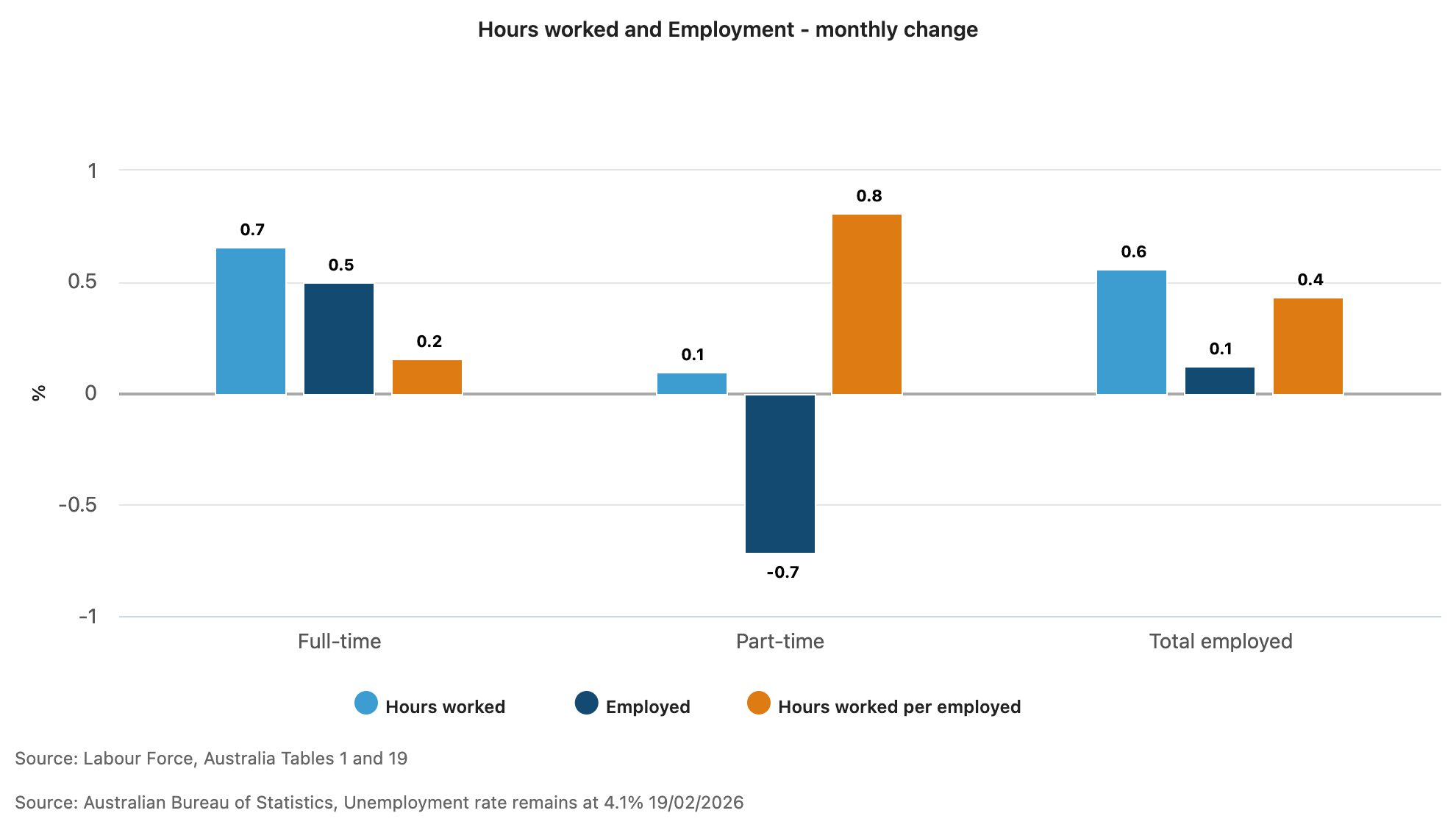
Despite the mixed jobs picture, total hours worked posted a stronger-than-expected increase of 0.6 per cent in January — outpacing overall employment growth for the month.
Crick attributed the divergence to seasonal factors, noting that “fewer people reported working less hours than typical Januarys due to being on leave,” which contributed to hours growing more strongly than headcount figures alone would suggest.
Full-time hours worked rose 0.7 per cent, while part-time hours worked increased by a more modest 0.1 per cent. Crick noted that while part-time workers individually logged more hours on average — with part-time hours per person rising 0.8 per cent — the overall pool of part-time workers shrank, limiting the total contribution from that segment of the workforce.
Trend Data Points to Gradual Improvement
On a trend basis, the picture was more encouraging. The trend unemployment rate fell from 4.2 per cent in December to 4.1 per cent in January — continuing a downward trajectory that has now extended across four consecutive months of declining unemployed persons.
Trend employment and hours worked each grew by 0.2 per cent in January. On an annual basis, hours worked grew faster than employment, suggesting that existing workers are absorbing more productive output even as hiring remains measured.
Outlook
The January figures cover the survey reference period of January 4 to 17, 2026. The ABS will next release February Labour Force data covering the period February 1 to 14, 2026.
Analysts and policymakers are expected to monitor youth underemployment and part-time work trends closely in the coming months, particularly as broader cost-of-living pressures continue to weigh on household budgets and workforce participation decisions across the country.
All data is sourced from the Australian Bureau of Statistics Labour Force, Australia, January 2026 report, released February 19, 2026.
Sustaining Mencari Requires Your Support
Independent journalism costs money. Help us continue delivering in-depth investigations and unfiltered commentary on the world's real stories. Your financial contribution enables thorough investigative work and thoughtful analysis, all supported by a dedicated community committed to accuracy and transparency.
Subscribe today to unlock our full archive of investigative reporting and fearless analysis. Subscribing to independent media outlets represents more than just information consumption—it embodies a commitment to factual reporting.
Not ready to be paid subscribe, but appreciate the newsletter ? Grab us a beer or snag the exclusive ad spot at the top of next week’s newsletter.