

Australia Delays AI Data Centre Regulation, Accelerates Approvals


Good morning, Australia!
Today, we’re tracking a constellation of urgent stories unfolding across the Pacific, the Middle East, and within Australia itself—each one revealing how quickly plans can pivot, how vulnerable ecosystems really are, and what happens when governments move too slowly on emerging threats.
Despite the financial challenges that our industry faces, we have decided to keep our reporting open to the public because we believe that everyone is entitled to know the truth about the events that shape their world.
Thanks to the unwavering support of our readers, we’re able to keep the news flowing freely. If you’re able, please join us in supporting Mencari.
Please support us and spread the word to your family and friends about our newsletter. As always, contact us via email and please remember to sign up for this newsletter here if you haven't already!
We'd love it if you could share the email with your friends! Just (copy the URL here.
In today’s email:
New Zealand Confirms First Case of H5N1 Bird Flu in Seabird
Two: Trump Reverses Controversial Strait of Hormuz Toll Plan After 24-Hour Reversal
Australia Delays AI Data Centre Regulation, Accelerates Approvals
🎧 Listen to the podcast
Today's reading time is 7 minutes. - Miko Santos 👇
MARKET CLOSE: 15 JULY 26
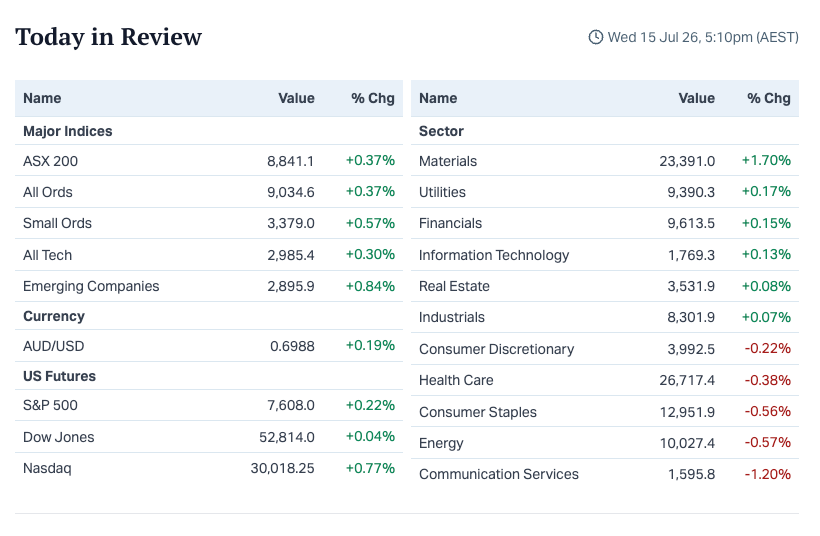
Data is provided by MARKET INDEX

New Zealand Confirms First Case of H5N1 Bird Flu in Seabird
New Zealand confirmed its first case of the deadly H5N1 bird flu on Wednesday after a brown skua seabird found on a beach near the capital tested positive, the country’s Biosecurity Minister announced. The detection is a significant moment for the island nation, which has spent months preparing for the virus’s arrival following recent confirmations in Australia and other countries worldwide.
The infected seabird was discovered near Wellington in the weeks following Australia’s first confirmed H5N1 detection in seabirds last month. While officials said there is currently no evidence of mass bird mortality, transmission among wild birds, or detection in poultry operations, the discovery underscores escalating concerns about the virus’s global spread.
“There is no evidence of any mass mortality in wildlife or transmission between wild birds in New Zealand. There has been no detection in poultry,” Biosecurity Minister Andrew Hoggard said in a statement Wednesday.
The H5 strain has devastated wild bird and mammal populations globally since 2021, killing millions of animals and infecting poultry farms and dairy operations across multiple continents. Some farm workers have also contracted the virus, though human transmission remains rare.
New Zealand’s wildlife faces extraordinary vulnerability to the virus compared to other nations. The country’s birds evolved for millions of years without native land mammals, resulting in many flightless, ground-nesting species poorly equipped to defend themselves against predators. Many are already critically endangered, prompting urgent conservation efforts.
In response, health officials launched an emergency vaccination programme targeting 300 core breeding birds from five of the nation’s most endangered species, including the flightless takahe and kakapo parrots. The initiative represents New Zealand’s primary defence against potential species extinction.
“We are incredibly worried about New Zealand’s biodiversity because our birds have never had to deal with anything like this virus before,” said Brett Gartrell, professor of wildlife health at Massey University. If it spreads quickly in New Zealand, we could face serious problems. Those core groups of birds that officials want to protect with the vaccination won’t be fully immune if it spreads too quickly.”
New Zealand has spent months coordinating with its poultry industry to develop biosecurity and resilience plans. Officials said the nation may experience a pattern similar to Australia’s outbreak, which has seen 14 confirmed or presumed positive detections in seabirds.

TOGETHER WITH MENCARI TRAVEL WIRE
Your Next Adventure Starts Here

Mencari Travel Wire is the go-to travel newsletter for Australia and New Zealand — delivering destination guides, travel intel, and trip-planning essentials curated for readers who move with purpose. Whether you’re chasing weekend escapes or planning your next big journey across the Tasman, we’ve got you covered.
Subscribe Free → TRAVEL WIRE
This section is a paid advertisement. If you are interested in advertising, let’s talk.
Trump Reverses Controversial Strait of Hormuz Toll Plan After 24-Hour Reversal
US President Donald Trump abandoned a proposal to impose a 20 per cent toll on all shipping through the Strait of Hormuz on Tuesday, reversing course just 24 hours after announcing the unprecedented plan on social media. The about-face came after intensive pressure from Gulf allies and advisors, who warned that the toll could destabilise global energy markets and contradict U.S. policy.
Trump announced the toll plan Monday morning on Truth Social, declaring the United States would be “THE GUARDIAN OF THE HORMUZ STRAIT” and vowing to charge fees on all cargo transiting the critical waterway. The directive sparked immediate alarm among regional partners and triggered a scramble within the Trump administration to determine implementation details.
Inside the White House, aides rushed to develop logistics for an unprecedented tolling system, including determining which parties would bear costs and how fees would be collected. Initial interpretations suggested shipping companies would pay, but confusion grew when Trump later declared Gulf allies would instead cover the costs.
Leaders from Saudi Arabia, the United Arab Emirates, Bahrain, and Qatar worked frantically to reach Trump by phone, urging him to abandon the plan. Their appeals proved effective. By Tuesday morning, Trump announced his reversal, saying Gulf partners had convinced him to pursue a different arrangement involving new investments in the United States instead.
“I put it out yesterday; I thought it was good,” Trump said Tuesday. I was called by various people from different countries, including kings and emirs, as well as many others whom we all know and love. And they’ve been, frankly, very strong partners. And they said we’d love to do it a different way.”
A White House official stated that Trump “wisely determined that the United States should be reimbursed for our many years of protecting ships transiting this waterway”, though Gulf allies have already committed trillions in investments with unclear spending timelines.
The episode underscored Trump’s transactional foreign policy approach and exposed significant vulnerabilities in the critical shipping lane. Despite Trump’s assertions that the war against Iran is effectively won, Iranian threats have sharply reduced shipping traffic and sent oil prices to levels unseen since before the U.S.-Iran peace agreement last month.
Secretary of State Marco Rubio had explicitly stated in late June that “no country is allowed to charge tolls or fees on an international waterway“, characterising such action as a violation of international law. Iranian Foreign Minister Abbas Araghchi quickly seized on Trump’s initial announcement, agreeing with the compensation concept while suggesting 20 per cent was excessive.
PRESENTED BY PODWIRES MARKETPLACE
Build Better Podcasts With Podwires

Every great podcast needs the right team behind it. Podwires is a dedicated marketplace where creators can connect with skilled podcast producers, editors, and audio professionals who understand how to shape strong, polished shows.
Built for the podcast industry, Podwires brings together talent, opportunity, and visibility in one clean platform. Whether you are launching a new show or improving an existing one, Podwires helps you find creative partners who can make your production stronger.
Podwires connects clients with top independent podcast producers and freelancers through a dedicated marketplace built for audio work.
Australia Delays AI Data Centre Regulation, Accelerates Approvals
Prime Minister Anthony Albanese announced plans to accelerate approval processes for data centre projects while postponing artificial intelligence regulation until early 2027, drawing sharp criticism from environmental advocates who warn that the delay creates a dangerous regulatory vacuum.
Albanese outlined a government strategy to provide “greater clarity and speed for approvals” for data centre proponents, acknowledging that these facilities place severe strain on Australia’s land, water, and clean energy resources. Despite recognising the strain, the government will not introduce AI legislation to Parliament until next year.
“The PM’s speech today shows that this government is kicking the can down the road, while Australians right around the country are calling for urgent regulations on AI data centres that are already being built in their backyard,” said Joe Rafalowicz, head of climate and energy at Greenpeace Australia Pacific.
Last month, Greenpeace Australia Pacific called on the federal government to implement an immediate moratorium on data centre approvals until binding regulations and safeguards are finalised. The environmental group argues that without oversight, Australia risks replicating environmental problems already emerging in the United States.
“Big tech companies are looking to make Australia their second home, but in the U.S., AI data centres are wreaking havoc on people’s health, drinking water and air by running their data centres on gas,” Rafalowicz said in a statement. “They’ve set their house on fire, and we shouldn’t be opening the door to let them do that here.”
The Green Party has also called for a moratorium on new data centre construction, characterising the government’s approach as creating a “free-for- all” until new laws take effect. Senator David Shoebridge criticised the timeline, stating that “a coordination office in Canberra doesn’t stop a single kid from being harmed tonight.”
Advocates seek regulations requiring 100 per cent additional renewable energy for new facilities and a complete ban on fossil fuels. Green Senator Sarah Hanson-Young emphasised that “just because big tech companies want to move at hyperspeed doesn’t mean that we need to fast-track and roll out the red carpet for them.”
The regulatory delay creates a six-month window during which major technology companies can pursue approvals without comprehensive oversight of environmental impacts.
SUPPORT MENCARI
The Mencari - Australia's Politics delivers fact-focused reporting to over 1,000 inboxes thanks to readers like you, and your contribution today will strengthen our ability to provide verified, evidence-based journalism completely free from financial or political influence as we work to establish ourselves as Australia's premier independent news organisation focused on accountability through thorough investigation.
Not ready to be paid subscribe, but appreciate the newsletter ? Grab us a beer or snag the exclusive ad spot at the top of next week's newsletter.
FROM OUR TEAM
📖 I appreciate you taking the time to read! See you in the next issue. Got a question or criticism? Just click on Reply. We can talk while we are here.
🎧 Check out our podcasts. This podcast seeks the truth to answer the most pressing questions using the highest journalistic standards
✍️ Give us a press release and a suitably-sized landscape photo. Make sure it's newsworthy. Send press releases to newsdesk@readmencari.com or click here. Editorially, we may rewrite headlines and descriptions.
🚀 Got a news tip ? Contact our editor via Proton Mail encrypted, X Direct Message, LinkedIn. You can securely message him on Signal by using his username, Miko Santos.
