

Australia Backs U.S. Strikes on Iran, Calls Death of Khomeini Figure a Warning to Regime
Prime Minister Anthony Albanese on Sunday backed United States military strikes against Iran, declaring that Australia supports American action to prevent Tehran from obtaining a nuclear weapon



This piece is freely available to read. Become a paid subscriber today and help keep Mencari News financially afloat so that we can continue to pay our writers for their insight and expertise.
Today’s Article is brought to you by Empower your podcasting vision with a suite of creative solutions at your fingertips.
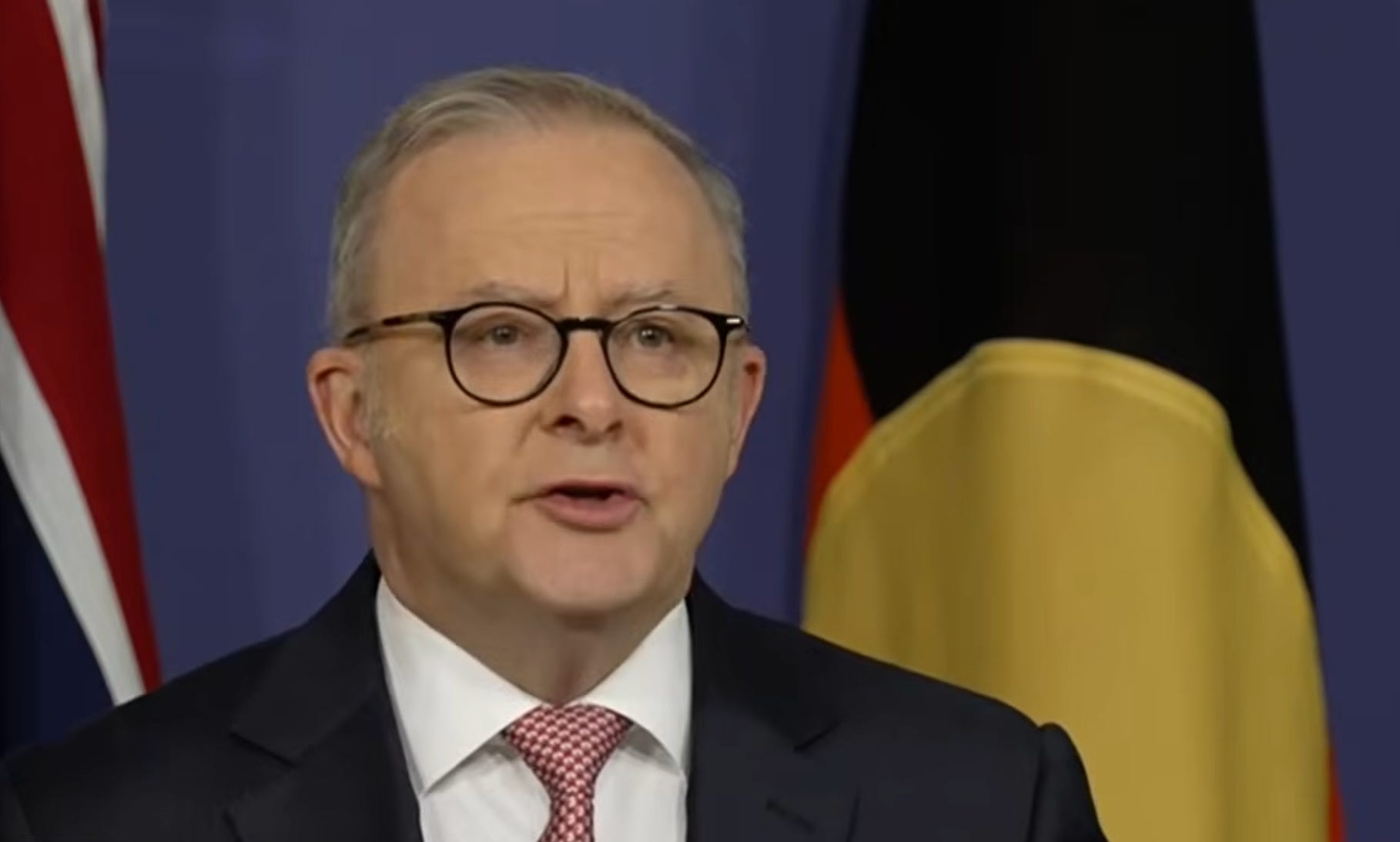
Prime Minister Anthony Albanese on Sunday threw Australia’s full diplomatic weight behind U.S.-led military strikes on Iran, condemning the Islamic Revolutionary Guard Corps as a sponsor of state terror and signaling that Canberra would not mourn the death of a senior Iranian regime figure whose passing he said went without grief from his government.
Speaking at an emergency press conference in Sydney, Albanese described the Iranian regime as a direct and documented threat to Australian soil, citing attacks orchestrated by the IRGC on Australian territory in 2024, including the firebombing of a Melbourne synagogue. His statement placed Australia among the coalition of Western nations tacitly or explicitly endorsing the military operation against Tehran.
“We support the United States acting to prevent Iran from obtaining a nuclear weapon and to prevent Iran from continuing to threaten international peace and security,” Albanese said.
The Prime Minister stopped short of confirming direct Australian military participation, stating that Australia was “not directly active in the current military strikes,” but left no doubt about his government’s position on the legitimacy of the operation.
The remarks came as Iran retaliated by bombing areas of Dubai, a move Albanese condemned in unequivocal terms.
“Iran has made the decision to take aggressive action and bomb areas of Dubai that have no role in any of this military action whatsoever,” he said. “This is an aggression and an escalation by Iran that is consistent with the nature of the regime.”
Albanese referenced the death of a senior Iranian leadership figure — identified in the transcript as associated with Iran’s ballistic missile and nuclear programs, its support for armed proxies, and brutal domestic repression — stating his passing “will not be mourned.” The Prime Minister said this figure had been responsible for orchestrating attacks on Australian soil.
On questions of legality, Albanese deferred to the United States and other direct participants in the strikes, but argued Iran’s documented threat to international peace and security spoke for itself.
“The threat to international peace and security of the Iranian regime is real,” he said. “The fact that they orchestrated attacks here in Australia, on the other side of the world, underlines the threat that this regime presented to the rule of law and to international norms of behaviour.”
When asked whether he had spoken with U.S. President Donald Trump or Israeli Prime Minister Benjamin Netanyahu, Albanese confirmed his government was “in contact with the United States over all of these issues” but did not confirm direct leader-to-leader communication.
Australia’s support, while stopping short of military involvement, reflects a significant alignment with Washington. The Albanese government has in recent years expanded its AUKUS commitments and deepened defence ties with the United States and the United Kingdom, making the prime minister’s statement consistent with a broader strategic posture in the Indo-Pacific.
Asked whether Australia would support a protracted military campaign or preferred a swift, narrow operation, Albanese was measured.
“Australia always supports diplomatic action where possible and we hope that the actions that have been taken lead to a swift resolution,” he said.
The Prime Minister framed Australia’s position as one of consistent principle rather than reactive opportunism, pointing to a series of extraordinary diplomatic steps his government had already taken against Tehran — expelling Iran’s ambassador, suspending the Australian embassy in Tehran, designating the IRGC as a terrorist organisation, and sanctioning more than 200 Iranian-linked individuals.
He expressed solidarity with Iranians who had risked their lives protesting against the regime, referencing brutal IRGC crackdowns on domestic dissent in which thousands were killed or imprisoned.
“This is a regime that we hope that the Iranian people are able to determine their own destiny,” Albanese said. “At the moment, that is clearly not the case.”
The Prime Minister also acknowledged the position of Australia’s Iranian-Australian community of approximately 50,000 people, recognising the anxiety many feel for relatives and friends inside Iran during the rapidly evolving crisis.
“I understand this is a very difficult time for the tens of thousands of Australians with loved ones in the Middle East,” he said. “The days ahead are going to be difficult. They are uncertain.”
Albanese declined to define any explicit red line for the extent of Australian support, instead indicating his government would monitor the situation hour by hour.
Sustaining Mencari Requires Your Support
Independent journalism costs money. Help us continue delivering in-depth investigations and unfiltered commentary on the world's real stories. Your financial contribution enables thorough investigative work and thoughtful analysis, all supported by a dedicated community committed to accuracy and transparency.
Subscribe today to unlock our full archive of investigative reporting and fearless analysis. Subscribing to independent media outlets represents more than just information consumption—it embodies a commitment to factual reporting.
Not ready to be paid subscribe, but appreciate the newsletter ? Grab us a beer or snag the exclusive ad spot at the top of next week’s newsletter.