

Albanese backs US-Israel strikes as Iran war engulfs middle east
Australia's Prime Minister throws explicit support behind joint military operations as Tehran burns, retaliatory Iranian missiles strike Gulf states, and global aviation networks collapse under the we


This piece is freely available to read. Become a paid subscriber today and help keep Mencari News financially afloat so that we can continue to pay our writers for their insight and expertise.
Today’s Article is brought to you by Empower your podcasting vision with a suite of creative solutions at your fingertips.
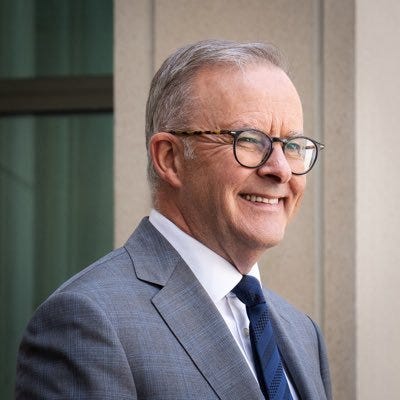
Australian Prime Minister Anthony Albanese declared unequivocal support Saturday for the United States-led joint military campaign against Iran, as explosions tore through Tehran, Iranian missiles struck American bases across the Gulf, and the conflict rapidly escalated into the most significant military confrontation the Middle East has seen in decades.
“Australia stands with the brave people of Iran in their struggle against oppression,” Albanese said in a statement posted to social media, backing US President Donald Trump’s vow to crush Iran’s military capability and eliminate its nuclear programme. “A regime that relies on the repression and murder of its own people to retain power is without legitimacy.”
The Prime Minister’s statement came as smoke rose above Tehran’s presidential district, sirens wailed over Jerusalem, and Iran’s Islamic Revolutionary Guard Corps fired retaliatory missiles at US military bases in Bahrain, Kuwait, the United Arab Emirates and Qatar. One person was killed by shrapnel from an Iranian missile in the UAE, according to that country’s defence ministry.
Trump, announcing what he called “major combat operations,” said the campaign’s objective was to “defend the American people by eliminating imminent threats from the Iranian regime.” Israeli Prime Minister Benjamin Netanyahu framed the joint operation as one that could “create the conditions for the brave Iranian people to take their destiny into their own hands.”
Australia’s Department of Foreign Affairs and Trade activated its Crisis Centre and issued emergency directives urging all Australians in Iran, Israel and Lebanon to leave immediately. The government also upgraded travel advice for Israel and Lebanon to its highest level — “Do Not Travel.”
ALBANESE CITES ATTACKS ON AUSTRALIAN SOIL
Saturday’s statement from Albanese offered the most comprehensive public account yet of Australia’s deteriorating relationship with Tehran and the domestic security events that preceded Canberra’s alignment with the US-Israel campaign.
The Prime Minister revealed that Iran directed at least two attacks on Australian soil in 2024, targeting the country’s Jewish community in acts he described as designed to “create fear, divide our society and challenge our sovereignty.” In response, Australia took what Albanese called “unprecedented steps” — expelling Iran’s Ambassador, suspending embassy operations in Tehran and formally listing the Islamic Revolutionary Guard Corps as a state sponsor of terrorism.
The government has since sanctioned more than 200 Iranian-linked individuals, including more than 100 with direct ties to the IRGC. Albanese said Australia had repeatedly called on Iran, alongside the United States and G7 partners, to uphold the human rights and fundamental freedoms of its citizens. “These calls have gone unheeded,” he said. “Instead, the regime has instigated a brutal crackdown on its own people, leaving thousands of Iranian civilians dead.”
Courtesy by @realDonaldTrump
NUCLEAR PROGRAMME AT THE HEART OF THE CRISIS
Central to both Albanese’s statement and the broader justification for Saturday’s military campaign is Iran’s nuclear programme, which the Prime Minister described as “a threat to global peace and security.” The United Nations Security Council has reimposed sanctions on Iran for failing to comply with the Joint Comprehensive Plan of Action. The International Atomic Energy Agency Board has formally declared Iran in non-compliance with its non-proliferation safeguards obligations.
An Israeli military official, briefing journalists Saturday, said Israel had identified a “sharp acceleration” in Iran’s missile production and renewed momentum in its nuclear programme. “They are developing dozens of ballistic missiles each month, and their pace of production is getting faster and faster,” the official said, describing a “dramatic expansion of an already dangerous arsenal.”
The strikes came just 24 hours after nuclear talks between Washington and Tehran collapsed without a deal. Trump, who had said publicly he was “not happy” with the progress of discussions, launched the military operation while a further round of negotiations had been tentatively scheduled for the following week. Guardian diplomatic editor Patrick Wintour noted the operation’s timing was nearly identical to a US-backed Israeli strike last June — launched three days before a sixth round of Iran-US talks — raising questions about Washington’s commitment to diplomacy.
Albanese said Australia “supports the United States acting to prevent Iran from obtaining a nuclear weapon and to prevent Iran continuing to threaten international peace and security.”
TEHRAN STRIKES: WHAT IS KNOWN
Explosions shook multiple districts of Tehran from the early hours of Saturday morning, with journalists from Agence France-Presse reporting loud blasts and columns of smoke rising across the city. Videos circulating on Iranian Telegram channels appeared to document strikes in Kermanshah near the Iraqi border, in Bushehr on the Persian Gulf, on an IRGC base near Mount Damavand, and on the Parchin military complex, which is alleged to produce chemical weapons.
Iran’s Supreme National Security Council issued a statement urging citizens to leave Tehran and major cities, advising the public to “travel to other centres and cities if possible to stay safe.” Schools and universities were closed until further notice. Banks remained open. Government offices were operating at 50 per cent capacity.
Iran’s supreme leader, Ayatollah Ali Khamenei, and President Masoud Pezeshkian were reported to have been among the targets of the strikes, according to Israeli officials. Khamenei is believed to have been evacuated from Tehran to a secure location. Iranian state media reported that Pezeshkian is “in full health.” Israel mobilised 70,000 reservists and deployed troops to its borders as the operation unfolded, with Israeli air defence systems working to intercept what the IDF described as a “barrage of missiles” launched from Iran toward Jerusalem and other population centres. Residents were evacuated from buildings struck by projectiles in Haifa, and Israelis took shelter in underground car parks across Tel Aviv.
IRAN STRIKES BACK ACROSS THE GULF
Iran’s IRGC confirmed it had launched missiles against US military bases across the Gulf in direct retaliation for the joint US-Israel assault. Explosions were reported near the US Navy’s Fifth Fleet headquarters in Bahrain, prompting Bahraini authorities to begin evacuating residents from the Juffair area south-east of Manama. Explosions were also reported in Kuwait, the UAE and Qatar.
The British Foreign Office issued an urgent directive to nationals across the Gulf: “British nationals in Bahrain, Kuwait, Qatar and United Arab Emirates should immediately shelter in place. Remain indoors in a secure location, avoid all travel and follow instructions from the local authorities.”
Gulf states moved quickly to close their airspace, triggering an immediate and widening collapse of international aviation across the region.
GLOBAL AVIATION NETWORK IN FREEFALL
The airspace closures set off a cascading disruption across the world’s busiest long-haul corridors, grounding flights between Europe, Asia, Australia and destinations throughout the Middle East. Among the carriers to cancel or suspend services: British Airways halted flights to Tel Aviv and Bahrain until March 3 and cancelled Saturday’s service to Amman; Lufthansa suspended services to Tel Aviv, Beirut and Oman until March 7 and pulled Dubai flights for the weekend; Qatar Airways suspended all flights in and out of Doha following the closure of Qatari airspace; Turkish Airlines cancelled services to Qatar, Kuwait, Bahrain, the UAE and Oman immediately and suspended flights to Lebanon, Syria, Iraq, Iran and Jordan until March 2; Wizz Air halted flights to Israel, Dubai, Abu Dhabi and Amman until March 7.
Norwegian Air, Virgin Atlantic, Air France, Aegean Airlines, Japan Airlines and Iberia Express also cancelled or suspended regional services. Heathrow Airport advised passengers to check directly with airlines, citing cancellations and delays “due to the ongoing situation in the Middle East and resulting airspace closures.”
Albanese’s DFAT urged all Australians — including those with no connection to the Middle East — to contact their airline or travel agent immediately to confirm flight status. Most standard Australian travel insurance policies provide no coverage for travel to Iran. The government specifically directed travellers to review their policies for provisions relating to flight cancellations, delays and changes in advisory levels.
DUAL NATIONALS FACE ACUTE DETENTION RISK
For Australians holding dual Iranian-Australian citizenship, Saturday’s escalation has created a situation of acute legal and personal danger. Iran does not recognise dual nationality, meaning Australian-Iranian citizens detained during the conflict may receive no formal consular access. The Australian Embassy in Tehran — suspended as part of the diplomatic measures Albanese outlined — has removed what was already a constrained safety net.
Dual nationals holding Iranian passports are required under Iranian law to exit the country on their Iranian travel document. Security forces’ response to protests has historically been severe, with documented injuries, deaths and mass detentions. The advisory urged all Australians in Iran to avoid public gatherings, demonstrations and crowds without exception, and to shelter in place with adequate supplies of water, food and medication if departure is not immediately safe.
DFAT acknowledged that in some previous cases, the Australian Government was not notified when a citizen was taken into custody in Iran — and that under current conditions, the capacity to intervene remains severely limited.
CONSULAR EMERGENCY CONTACTS
The Department of Foreign Affairs and Trade has activated its Crisis Centre to support Australians across the region.
Within Australia: 1300 555 135 International: +61 2 6261 3305 Available 24 hours, 7 days
Sustaining Mencari Requires Your Support
Independent journalism costs money. Help us continue delivering in-depth investigations and unfiltered commentary on the world's real stories. Your financial contribution enables thorough investigative work and thoughtful analysis, all supported by a dedicated community committed to accuracy and transparency.
Subscribe today to unlock our full archive of investigative reporting and fearless analysis. Subscribing to independent media outlets represents more than just information consumption—it embodies a commitment to factual reporting.
Not ready to be paid subscribe, but appreciate the newsletter ? Grab us a beer or snag the exclusive ad spot at the top of next week’s newsletter.