

Albanese Accepts Responsibility for Anti-Semitism Failures Amid Criticism of Terror Attack Response



This piece is freely available to read. Become a paid subscriber today and help keep Mencari News financially afloat so that we can continue to pay our writers for their insight and expertise.
Today’s Article is brought to you by Empower your podcasting vision with a suite of creative solutions at your fingertips.

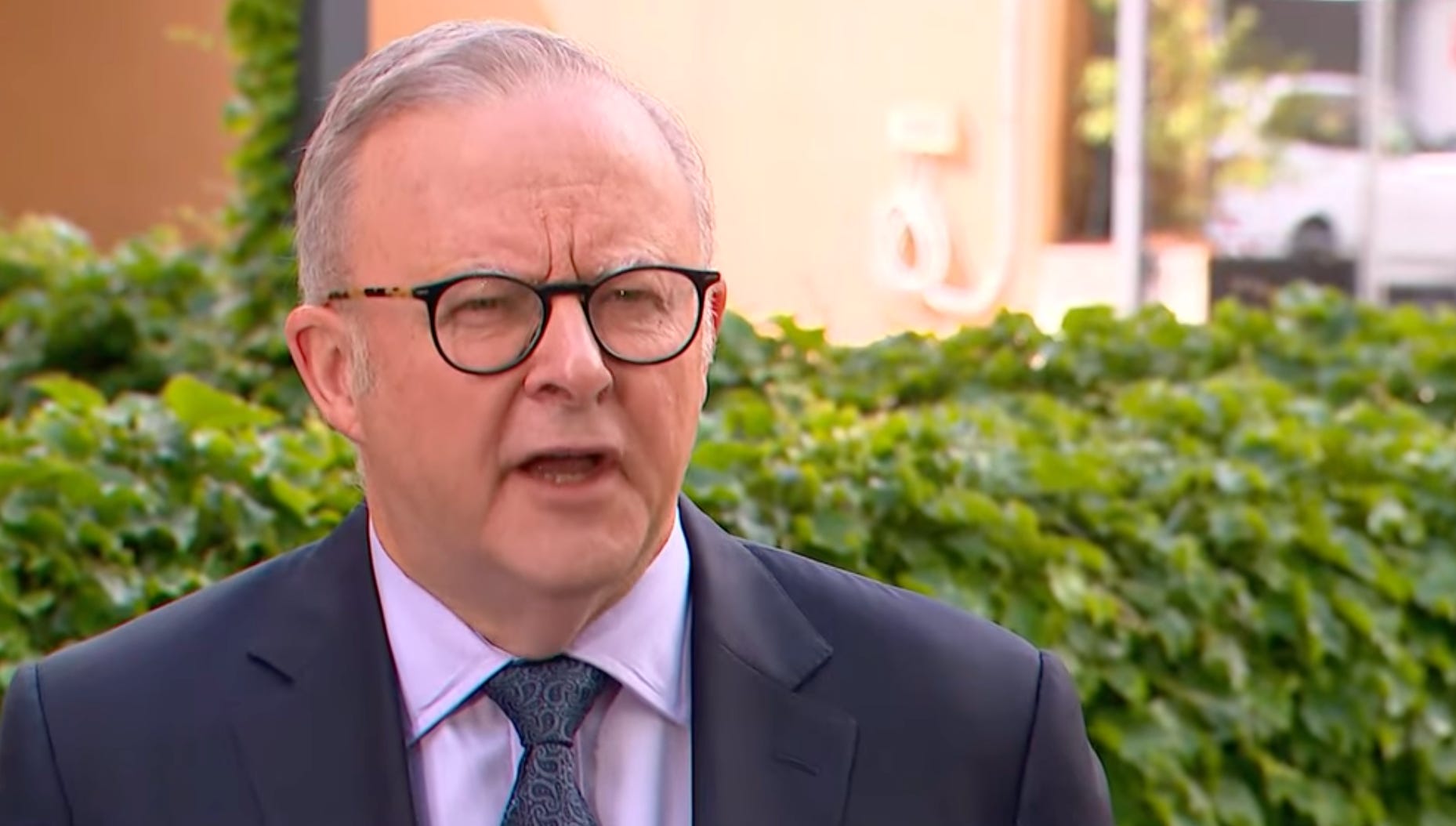
Prime Minister Anthony Albanese acknowledged Friday that more should have been done to combat anti-Semitism before a terrorist attack killed 15 Jewish Australians, accepting his share of responsibility while defending his government’s response to the Bondi Beach massacre that has drawn intense political criticism.
The admission came during a press conference announcing sweeping legislative reforms targeting hate speech and anti-Semitism, with Albanese facing repeated questions about why he had not publicly attended victims’ funerals and whether the government acted swiftly enough to address rising anti-Semitism since October 2023.
“There was always more that could have been done,” Albanese said, his first direct acknowledgment of governmental shortcomings since the December 14 attack. “As the Prime Minister, I accepted my share of the responsibility for that and accepted my share of the responsibility going forward to make a change to see that this sort of thing couldn’t happen again.”
The statement represents a significant shift for Albanese, who throughout the week following the attack emphasized actions his government had already taken rather than acknowledging inadequacies. Opposition Leader Sussan Ley and other critics have questioned whether the government moved too slowly on anti-Semitism despite warnings from Jewish community leaders about escalating threats.
Funeral Attendance Controversy
Albanese faced pointed questioning about his absence from public funerals for attack victims, which began Thursday and continued Friday with services for 10-year-old Matilda, grandfather Tibor Whiteson, and Holocaust survivor Alexander Claytman. Opposition figures including Ley and Shadow Attorney-General Julian Leeser attended Matilda’s funeral while Albanese remained in Canberra chairing the National Security Committee.
Asked directly whether he or his office requested to attend victim funerals, Albanese confirmed that he had reached out to families and made clear his willingness to attend services. However, he emphasized respect for grieving families’ wishes rather than public appearances.
“I have reached out to families. I have made it clear,” Albanese said. “Today I’ve chaired the National Security Committee here. We are acting, but I have met with families. I’ve spoken on the phone with families and I will continue to engage.”
PressCon: Albanese Announces Hate Speech Reforms After Bondi Terror Attack

Prime Minister Anthony Albanese announced sweeping hate speech legislation Thursday following a terror attack at Sydney’s Bondi Beach that killed 15 people, including a 10-year-old girl, though he resisted mounting pressure to convene Parliament immediately or establish a Royal Commission into the massacre.
The National Security Committee agreed to five broad legislative changes targeting antisemitic violence, including new aggravated offenses for leaders who promote violence, increased penalties for hate speech, and provisions to list organizations whose leaders engage in incitement. The Attorney-General and Home Affairs Minister will develop the specific legislation.
The Prime Minister said he understood that people were grieving and deserved respect during their traumatic experience. When pressed on whether fulfilling his responsibility to stand and unite the nation had been difficult given community anger, Albanese deflected focus from his own challenges.
“I’ve had some difficult conversations but my job isn’t difficult here,” he said. “The difficulty is with the families who are grieving of these victims. That’s who my sympathy is for because it is them who are going through an incredibly traumatic experience.”
Private Engagement Strategy
Albanese emphasized private meetings with families rather than public memorials as his preferred approach to engagement. He cited meetings at Admiralty House the night before the press conference and an interfaith vigil at St Mary’s Cathedral on Thursday evening that was broadcast publicly.
“I understand last night my understanding is that the St Mary’s Cathedral event was broadcast. I engaged with people there for some time,” Albanese said, describing the interfaith gathering as uplifting.
The Prime Minister defended his decision to prioritize governmental response over public grief displays, noting that he chaired the National Security Committee on Friday to develop the comprehensive policy package announced at the press conference. Officials said he has been working intensively on the response since the attack occurred.
However, the absence of the Prime Minister from public funerals while opposition leaders attended has fueled criticism about whether Albanese adequately demonstrated solidarity with grieving Jewish Australians. Political observers noted the optics of opposition figures mourning publicly while the Prime Minister worked behind closed doors.
Criticism of Pre-Attack Response
The broader criticism extends beyond funeral attendance to questions about whether the government acted aggressively enough on anti-Semitism during the 14 months since Hamas attacked Israel in October 2023, triggering the current Gaza conflict and a surge in anti-Semitic incidents in Australia.
Jewish community leaders have documented increased vandalism of synagogues, harassment of individuals displaying Jewish symbols, threatening rhetoric at protests, and general anxiety about safety in public spaces. The Special Envoy to Combat Anti-Semitism, Gillian Siegel, delivered her report with 13 recommendations in July 2025, but comprehensive government action was not announced until after the Bondi attack.
Albanese defended the government’s record, noting that Parliament had already legislated against hate speech, hate crimes, hate symbols, and doxing. The government also appointed the first National Student Ombudsman and began developing Siegel’s university report card system.
“We have already legislated for hate speech, hate crimes, hate symbols, outlawing doxing,” Albanese said. “We have already undertaken education action, including appointing the first ever student ombudsman and the development of the envoy’s report card on universities.”
However, critics argue these measures, while positive, did not adequately address the scope of the problem or move quickly enough to prevent escalation toward violence. The Bondi attack has intensified debate about whether earlier, more aggressive action might have deterred the Islamic State-inspired terrorist.
Personal Experiences with Harassment
Albanese shared personal experiences of harassment directed at his parliamentary office in Marrickville, describing attacks and vilification of staff members trying to help constituents with Medicare and Social Security matters. He suggested these incidents reflected broader breakdown of civil discourse.
“I have an office that has closed on Marrickville Road where people were attacked, vilified, people just trying to get help with Medicare or Social Security,” Albanese said. “Now, that’s been very difficult, but nothing like the difficulty of families.”
The Prime Minister recounted a Tuesday meeting with a Bondi Junction resident who described being harassed while shopping in Sydney with her son on a Sunday. “That’s not the Australian way,” Albanese emphasized, using the anecdote to illustrate how anti-Semitism has affected Jewish Australians’ daily lives.
Opera House Protest
Albanese defended his response to a controversial October 2023 protest at the Sydney Opera House where demonstrators chanted slogans that Jewish community leaders characterized as anti-Semitic. The Prime Minister said he called for the protest not to proceed on the day it was scheduled and condemned it afterward.
“I called for on the day of the Opera House demonstration I thought was completely reprehensible. I called for it not to go ahead on the Monday and condemned it on the day after,” Albanese said.
However, critics noted that the condemnation came after the protest occurred rather than preventing it, and that subsequent protests continued with rhetoric that Jewish Australians found threatening and offensive. New South Wales Premier Chris Minns has faced similar criticism about state police response to protests.
Respectful Disagreement
The Prime Minister emphasized the need for respectful political discourse even on contentious issues, arguing that lines have been crossed in debates related to the Israel-Gaza conflict and anti-Semitism.
“We need to be able to have political discourse in this country which is respectful and to respectfully disagree,” Albanese said. “But a line has been crossed over and over again in the way that some of this debate has been conducted.”
This comment appeared directed at both extremes of the Israel-Gaza debate, with Albanese suggesting that legitimate disagreement about Middle East policy has escalated into unacceptable harassment and hatred targeting Australian Jews who bear no responsibility for foreign government actions.
Reaching for Light
When questioned about the difficulty of fulfilling his responsibility to lead and unite Australians given community anger, Albanese used religious imagery to describe his approach. He noted that the attack targeted people celebrating Hanukkah, the Jewish festival of light, on its first evening.
“What we saw was an attempt to extinguish light and promote darkness. That is what terrorism does,” Albanese said. “My job is to continue to reach for light. That is what I’ll continue to do.”
The metaphor framed the Prime Minister’s role as maintaining hope and solidarity despite grief and anger, suggesting that his measured approach represents steadiness rather than inadequate emotion.
Bipartisan Elements
Despite criticism from opposition figures, some elements of the government’s response have drawn bipartisan support. Ley and other Coalition leaders have praised the legislative reforms announced Friday while maintaining that the government should have acted sooner.
The presence of opposition figures at victim funerals demonstrates cross-party solidarity with the Jewish community even as political debate continues about governmental adequacy. Shadow Attorney-General Leeser, who represents a constituency with significant Jewish population, has been particularly active in engaging with affected families.
Both major parties support strengthening hate speech laws and enhancing security for Jewish institutions, though they differ on specific approaches and timelines. The Coalition has called for immediate parliamentary recall to pass legislation rather than waiting until February 2026 when Parliament is scheduled to resume.
Moving Forward
Albanese indicated that additional announcements would follow in coming days, particularly regarding gun control measures coordinated with New South Wales. The multi-day rollout of policy responses suggests ongoing governmental work rather than a complete package announced at once.
Minister for Home Affairs Tony Burke acknowledged that the proposed legislation is complex and will require consultation to design properly. Burke said the government aims to shift legal thresholds that have allowed hate groups and individuals to operate just within existing law.
“For too long, there have been two sorts of occasions where people have gone right to the limits of the law but have managed to stay on the legal side of it,” Burke said, explaining the rationale for new offenses and enhanced penalties.
Community Expectations
Jewish community leaders have expressed appreciation for the government’s comprehensive response while emphasizing that implementation will determine success. Siegel, the Special Envoy, welcomed the government’s adoption of her plan but noted that detailed work remains to translate recommendations into concrete action.
“I’m looking forward and I expect the full cooperation of the government, as the Prime Minister has announced, with its ongoing implementation,” Siegel said.
The test for Albanese’s government will be whether announced measures translate into tangible improvements in Jewish Australians’ safety and security. Community advocates have emphasized that sustained commitment rather than temporary attention following tragedy is necessary to combat anti-Semitism effectively.
Political analysts noted that Albanese’s acknowledgment of past failures represents an attempt to demonstrate accountability while pivoting toward action. Whether this approach satisfies critics or addresses community concerns remains uncertain as recovery and implementation proceed.

Bias Explanation: This piece leans Centrist/Progressive because it centers institutional voices (government, police, community organizations) while framing the issue through justice and minority safety. The Jewish Board and National Imams Council — both moderate community organizations — dominate sourcing.
Policy prescriptions span the spectrum: gun control (typically progressive) alongside protest restrictions (typically conservative). The emphasis on cultural transformation and systemic change pulls it toward Progressive, while the institutional trust and democratic process framing keeps it Centrist. Right-Wing elements appear only in anti-terrorism and security frames. The story avoids partisan political actors, which keeps extremes at zero.
Bias comparisons derive from an AI-assisted evaluation of content sources and are protected by copyright held by Mencari News. Please share any feedback to newsdesk@readmencari.com
Sustaining Mencari Requires Your Support
Independent journalism costs money. Help us continue delivering in-depth investigations and unfiltered commentary on the world's real stories. Your financial contribution enables thorough investigative work and thoughtful analysis, all supported by a dedicated community committed to accuracy and transparency.
Subscribe today to unlock our full archive of investigative reporting and fearless analysis. Subscribing to independent media outlets represents more than just information consumption—it embodies a commitment to factual reporting.
Not ready to be paid subscribe, but appreciate the newsletter ? Grab us a beer or snag the exclusive ad spot at the top of next week’s newsletter.